KRONS Labs — Open Harnesses & Tournament Engineering
The engineering foundry of KRONS (`krons.tech` / `labs.krons.tech`): designing universal 9-element worker harnesses, developing isolated release candidates in worktrees, and selecting architectures through tournament evidence.
Core Principle: Open Harness + Interchangeable Model + Connectable Memory + Controlled Tools.
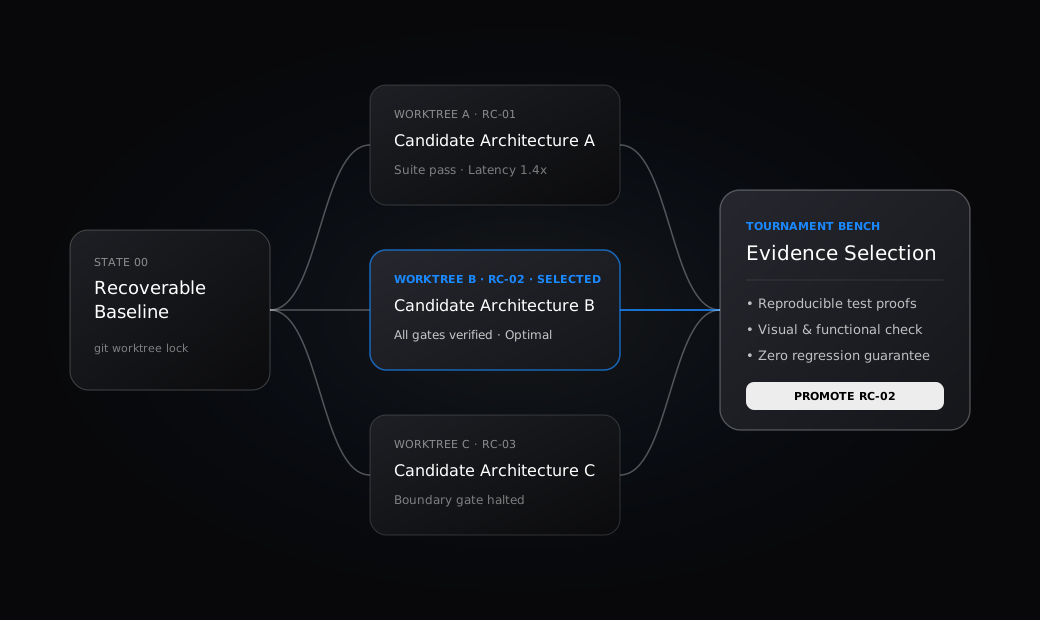
Manufacturing & Validation Method: recoverable baseline → isolated worktrees → release candidates (RC) → tournament bench → evidence-based selection.
Operational Honesty: shipping a harness provides the verified operational structure; live execution binds environment-specific models, memory, and gates.
Manufacturing & Tournament Validation Protocol
Every harness and system module in KRONS Labs is built, isolated, and selected through reproducible evidence.
Recoverable Baselines & Worktrees
Every architectural modification starts from a locked recoverable state and branches into isolated git worktrees so multiple candidates can be built simultaneously.
Comparative Tournament Bench
Release candidates compete against identical reproducible test suites, boundary-violation probes, and latency/accuracy benchmarks.
Gate Verification & Registry
Only candidates that pass functional, visual, and contract verification are promoted into the KRONS Harness Library.
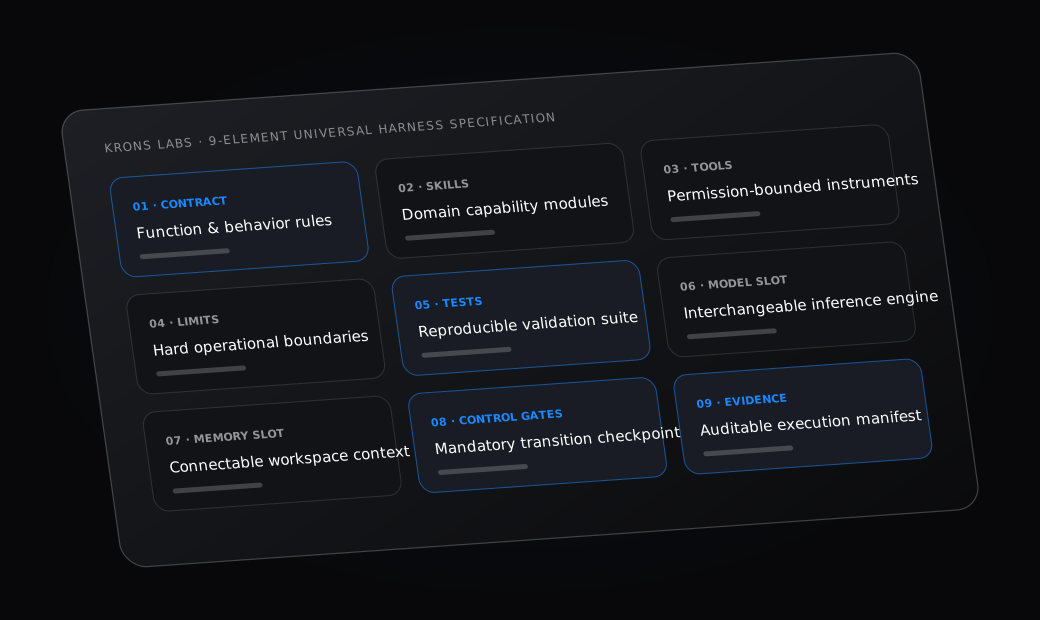
The 9 Structural Elements of a KRONS Harness
Core principle: Open Harness + Interchangeable Model + Connectable Memory + Controlled Tools.
01 · Function Contract
Defines the operational role, expected behavior, input/output schemas, and strict boundaries of the worker.
02 · Domain Skills
Structured capabilities engineered for quantitative finance, systems architecture, or regulatory analysis.
03 · Controlled Tools
Explicit, permission-scoped instruments that the harness is authorized to invoke during execution.
04 · Operational Limits
Hard boundaries specifying what the worker cannot execute, approve, or extrapolate autonomously.
05 · Reproducible Tests
Deterministic validation suites verifying behavioral compliance prior to deployment.
06 · Interchangeable Model
Swappable inference slot selected strictly for its fit to the task and harness rules.
07 · Connectable Memory
Workspace-scoped memory interface attaching verified historical context and domain corpora.
08 · Control Gates
Mandatory verification checkpoints enforcing schema and policy compliance at every state transition.
09 · Verifiable Evidence
Auditable provenance log capturing inputs, gate checks, and outputs for every execution.
Labs — Architectural Planes & Sequences
Interactive perspective compositions illustrating the operational layers of this KRONS line.
The 9-Element Harness
Contract, skills, tools, boundaries, reproducible tests, model slot, connectable memory, control gates, and verifiable evidence.
Complementary Structural Schematic
Every visual composition in KRONS is engineered as a resolution-independent vector diagram coupled with deterministic operational specifications.
Connected Areas in KRONS
Navigate directly to adjacent architectural lines and operational surfaces.
Systems
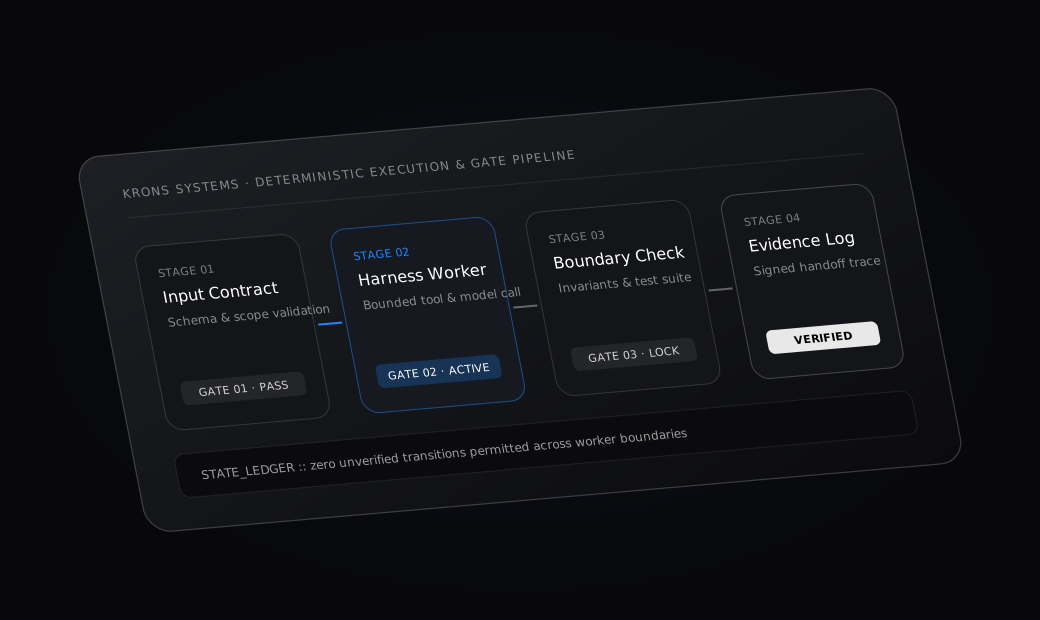
The structural backbone of KRONS: governing how specialized functions communicate, pass verified work artifacts, enforce execution gates, and preserve end-to-end auditability.
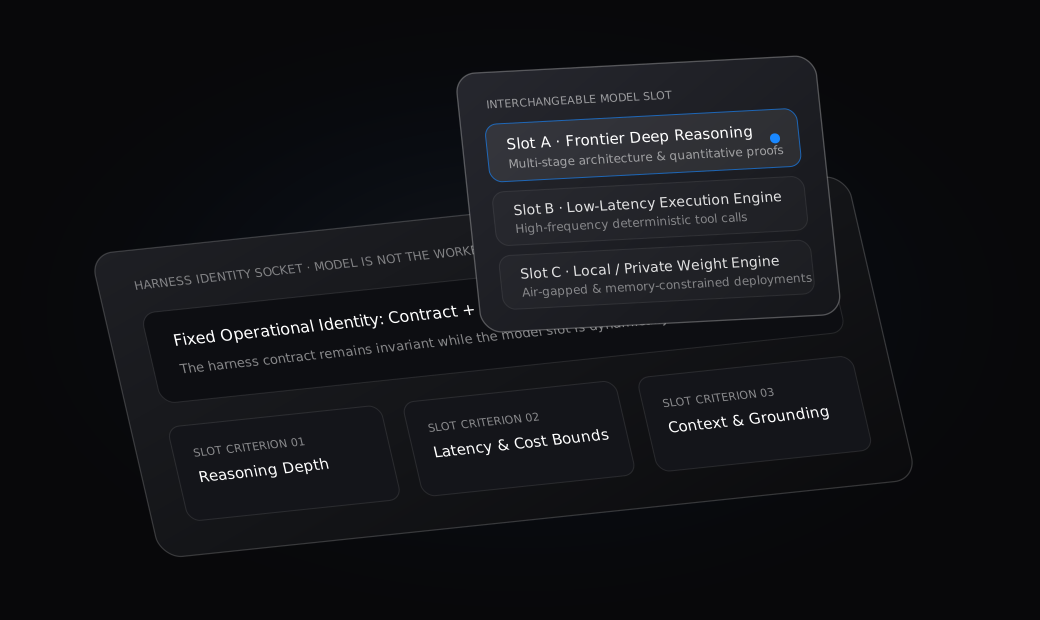
Models
In KRONS, the language model is never the worker’s identity. The harness defines the operational identity; the model occupies an interchangeable slot selected strictly for its adequacy to the task and harness rules.